Coaching Strategies for Trauma Recovery and Growth
Last Updated: November 4, 2026
Quick Summary
Coaching strategies for trauma recovery and growth are structured, forward-looking steps that help you calm your nervous system, process past experiences, and set meaningful goals. Trauma-informed coaching moves from consent and safety through stabilization, goal-setting, growth work, and review. It complements care from licensed clinicians but is not psychotherapy or medical treatment.
- Coaching follows five steps: consent and safety, stabilization, goal-setting, growth work, and review.
- Trauma-informed coaching centers safety, trust, choice, and collaboration, and you set the pace.
- Coping strategies are grouped by purpose: steadying, processing, recovery, and connection.
- Start with one new habit at a time rather than stacking many practices at once.
- A 68.8% recovery rate was reported in one PTSD coaching study sample, not a guaranteed outcome.
Table of Contents
- What Trauma Recovery Coaching Is and Is Not
- Trauma-Informed Principles That Shape Every Session
- Positive Coping Strategies for Trauma
- Grounding Techniques for Stress in the Moment
- Building Self-Awareness, Emotional Intelligence, and Meaningful Goals
- Post-Traumatic Growth Through Coaching
- Starting Your Own Recovery Path With Spence's True North
- Frequently Asked Questions
What Trauma Recovery Coaching Is and Is Not
Trauma recovery coaching is a structured, forward-looking partnership that helps you move from survival mode toward a life you can direct, and it is one of the coaching strategies for trauma recovery and growth that Spence's True North offers. At Spence's True North, our trauma-informed coaching supports you in calming your nervous system, processing what you have lived through, and setting goals that matter to you. It is not psychotherapy, medical treatment, or psychiatric care, and it does not diagnose or treat any condition.
Coaching works best as a complement to the care you already have, or as a next step when you are ready to apply coaching strategies for trauma recovery and growth to present-day life and what comes next. Recent research on a cognitive therapy coaching intervention for PTSD found that 68.8% of participants who were above the clinical cutoff at baseline met reliable recovery criteria by the end of the intervention (Evaluation of SHAPE cognitive therapy coaching for PTSD). That result describes one study sample, not a guarantee for every client.
How coaching differs from psychotherapy and medical care
Psychotherapy and medical care focus on diagnosing and treating illness. Coaching focuses on your strengths, your goals, and the skills you use day to day. A coach does not assess mental health conditions, prescribe treatment, or replace a clinician.
If you are experiencing a crisis, thoughts of harming yourself, or symptoms that affect your safety, contact a licensed provider, your local emergency number, or the 988 Suicide and Crisis Lifeline right away.
Trauma-Informed Principles That Shape Every Session
Trauma-informed coaching starts from one question: what does this person need to feel safe enough to do the work? Every session is built around safety, trust, choice, and collaboration. You set the pace, and you decide what to share.
Those principles are easier to trust when you can see how they turn into practice. A common pattern in trauma-informed coaching moves through a clear sequence:
- Consent and safety first. Before any deeper work, you and your coach agree on what the sessions will and will not cover, how you will signal that you need to slow down, and what happens if something feels like too much.
- Stabilization. Early work focuses on steadying strategies, routines, and support so you have something to stand on before you look at harder material.
- Goal-setting. Once you feel steadier, you name what you want to move toward, such as rebuilding trust with family, returning to work with more confidence, or handling conflict without shutting down.
- Growth work. This is where self-awareness, emotional intelligence, and communication skills are practiced and reviewed.
- Review. You and your coach look honestly at what is changing, what is not, and what to adjust.
Scope of practice and referral. Coaching is not psychotherapy, medical treatment, or psychiatric care. A coach does not diagnose or treat any condition, does not prescribe, and does not replace a clinician. Coaching focuses on your strengths, your goals, and the skills you use day to day.
Adapting to different experiences and identities. Trauma does not look the same for everyone, and a one-size-fits-all approach does not serve people well. Veterans, first responders, 911 dispatchers, healthcare workers, and trauma survivors often carry different pressures and different cultures around asking for help. Deepening this work sometimes requires the specialized clinical expertise of a trauma-informed therapist to navigate the complex intersections of personal history and professional identity.
The University of Denver's Butler Institute describes coaching as supporting self-awareness and emotional intelligence while helping clients move from the past toward the present (Supporting Post-Traumatic Growth Through Coaching). Trauma-informed practice also emphasizes collaboration and empowerment over control, which reduces the risk of re-traumatization.
Measuring progress responsibly. Progress in coaching is reviewed against goals you define, along with functioning, confidence, and how safe you feel day to day. These are non-clinical markers, and they are not a substitute for clinical assessment. No coach can guarantee a particular outcome, and any coach who does should give you pause.
Positive Coping Strategies for Trauma
Coping strategies are the practical actions you use to get through hard moments and rebuild steadiness over time. To learn how to recognize when your nervous system is overwhelmed so you can pick the right response, read signs of nervous system dysregulation.
Steadying strategies are for the moment stress rises.
Processing strategies are for when you have enough steadiness to reflect. Journaling, talking with a trusted friend, prayer if faith is meaningful to you, or reviewing what triggered a reaction and what helped.
Recovery strategies are for the hours and days after a difficult period. Sleep routines, meals, movement, time with people who feel safe, and lowering demands where you can. Recovery is part of the work, not a reward for finishing it.
Connection strategies are for staying linked to others. A short check-in call, a peer support group, a walk with a friend, or time with family. Isolation often feels safer in the moment and makes recovery harder over time.
Start with a short list of strategies you already know work for you, then add one new habit at a time. Track what helps and what does not, and adjust.
Schedule a free consult call →
Watch out: stacking too many new practices at once is a common way people set themselves up to feel like they are failing. One new habit at a time is usually enough.
Between sessions and during setbacks. You do not need to wait for a session to use these strategies, and you do not need to disclose or revisit trauma to practice them.
Explore our nervous system regulation practices alongside these exercises, and try each one before you need it so it feels familiar under pressure.
Grounding Techniques for Stress in the Moment
Grounding techniques bring your attention back to the present when stress or memories pull you away. For practical grounding and somatic exercises for anxiety in high-stress situations, see nervous system regulation for anxiety. They are simple, require no equipment, and can be used anywhere.
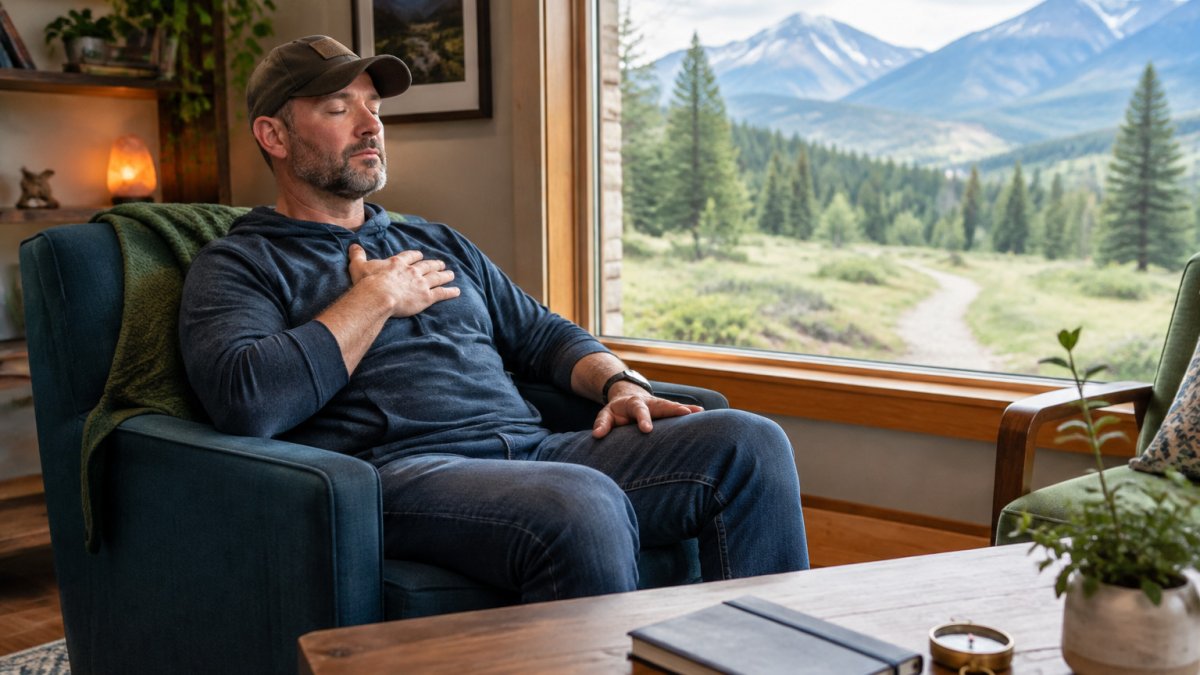
- Name five things you can see, four you can touch, three you can hear, two you can smell, and one you can taste.
- Place both feet flat on the floor and notice the support beneath you.
- Slow your exhale so it is longer than your inhale, and repeat for a few breaths.
Explore our nervous system regulation practices alongside these exercises, and try each one before you need it so it feels familiar under pressure.
Here is a quick reference for the three grounding techniques described above, so you can reach for the right one when stress rises.
| Technique | How to do it | Best for |
|---|---|---|
| 5-4-3-2-1 sensory naming | Name five things you see, four you touch, three you hear, two you smell, one you taste | Pulling attention back to the present |
| Feet on the floor | Place both feet flat and notice the support beneath you | Feeling unsteady or detached |
| Longer exhale | Slow the exhale so it is longer than the inhale, and repeat for a few breaths | Calming the body during stress |
Building Self-Awareness, Emotional Intelligence, and Meaningful Goals
Self-awareness is the foundation for lasting change. When you can name what you feel and notice the patterns behind your reactions, you gain choices you did not have before. Emotional intelligence builds on that by helping you respond to people and situations rather than reacting automatically.
Meaningful goals give that growth a direction. Choose one goal that reflects what you value, such as rebuilding trust with your family or returning to work with more confidence, and break it into steps you can take this week. Review your progress honestly and adjust as you learn.
Post-Traumatic Growth Through Coaching
Post-traumatic growth describes positive change that some people experience after living through adversity, such as a deeper sense of meaning, stronger relationships, or a clearer sense of personal strength. It does not mean the trauma was acceptable or that you should feel grateful for it.
A randomized controlled trial of a life-coaching intervention examined its effects on post-traumatic growth and fear of cancer recurrence, showing that structured coaching can be studied as a support for growth (The Effect of Life Coaching on Post-Traumatic Growth). Growth often unfolds gradually, and setbacks are a normal part of it.
Starting Your Own Recovery Path With Spence's True North
Recovery is personal, and the right first step is the one that feels manageable to you. Spence's True North provides confidential, trauma-informed coaching through secure telehealth, including individual coaching and the 25-week T.R.U.E. North Protocol. Explore our coaching services to see how the sessions are structured, or book a free consultation to talk through your goals and whether coaching is a good fit.
Our founder, Edward J. Spence, is a disabled military veteran, former firefighter and paramedic, and ordained chaplain. Sessions are offered with dignity regardless of background, and faith-based support is available only when you request it. Pricing can include a sliding scale, so cost does not have to stand in the way of getting support.
Frequently Asked Questions
What is trauma recovery coaching?
Trauma recovery coaching is a structured, forward-focused partnership in which a trained coach helps you process the effects of past experiences, build practical coping skills, and set goals for daily life. It is educational and supportive rather than clinical. Coaching does not diagnose or treat mental health conditions. Many people use coaching alongside therapy, and a coach can help you identify when a licensed professional would be a better fit.
How is trauma-informed coaching different from psychotherapy?
Psychotherapy is delivered by licensed clinicians who can diagnose and treat mental health conditions. Trauma-informed coaching focuses on present-day goals, self-awareness, and practical strategies, and it does not diagnose or treat illness. Coaching emphasizes collaboration, choice, and safety. If you have symptoms that interfere with safety or daily functioning, a licensed mental health provider or medical professional should be part of your care.
What positive coping strategies can help with trauma?
Useful coping strategies include keeping a simple daily routine, scheduling physical activity, using journaling to notice patterns, connecting with trusted people, and practicing paced breathing. Many people also find that naming their reactions without judgment reduces their intensity. Coaching can help you choose strategies that fit your life, track what works, and adjust when a method stops helping. Results vary, and no single strategy suits everyone.
Can grounding techniques help with stress right away?
Grounding techniques redirect attention to the present moment. Examples include slowing your exhale, naming five things you can see, pressing your feet into the floor, or holding a cool object. These methods are simple to practice and can help during a stressful moment. They work best when practiced during calm periods first, so they feel familiar when you need them. They are not a substitute for professional care if stress is severe or persistent.
Does trauma recovery coaching guarantee results?
No coaching service can guarantee specific outcomes, and Spence's True North does not make that claim. Progress depends on your goals, your circumstances, your willingness to practice between sessions, and many other factors. Coaching offers structure, accountability, and education to support your own efforts. A free initial consultation can help you decide whether the approach fits your needs.
Who can benefit from trauma recovery coaching?
Coaching is offered to veterans, active duty members, first responders, 911 dispatchers, healthcare workers, trauma survivors, couples, and families. Services are delivered through secure telehealth, and faith-based support is available only when you request it. Every person is treated with dignity regardless of background or circumstances. If you are in crisis or have thoughts of harming yourself, contact 988 (the Suicide and Crisis Lifeline) or emergency services right away.
How do I get started?
Begin with a free initial consultation to talk about your experiences, goals, and questions. This is a conversation to learn whether the approach fits you. Pricing may include a sliding scale so finances do not prevent you from receiving support. For current details on services and fees, visit the Spence's True North website or contact the team directly.
